




















































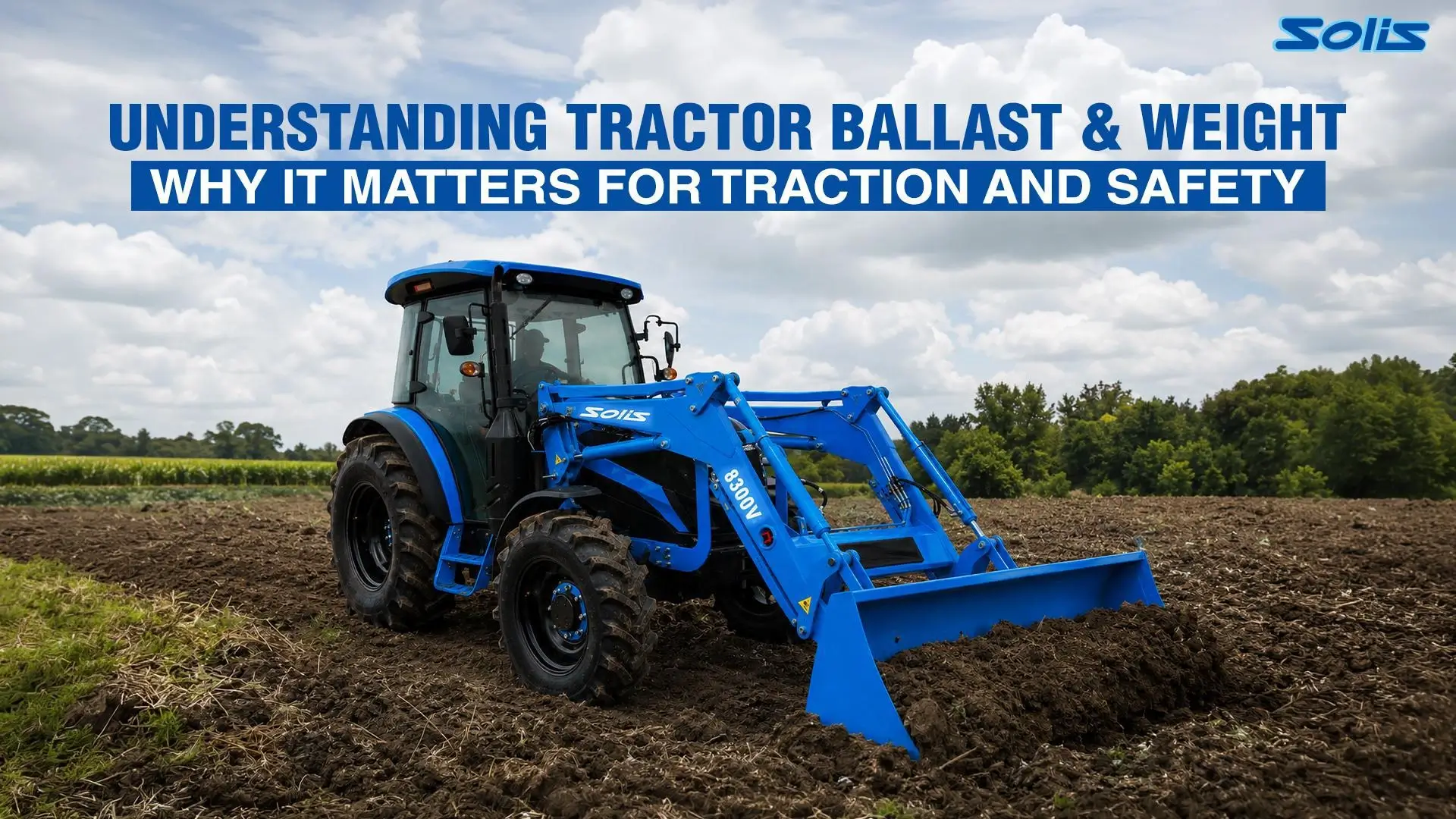
Your tractor can have a powerful engine with plenty of horsepower and torque, but that power disappears after your wheels spin instead of providing grip due to the lack of the right tractor ballast weight. Believe it or not, it’s familiar to many tractor owners. The engine is strong, but the machine struggles on soft ground. The loss of performance is not always due to horsepower; sometimes it’s about weight and where it sits.
Tractor ballast means additional weight, whether from front or rear weights, wheel weights or tyres filled with liquid. It’s used to add more traction, improve handling, safety and stability. Get the ballast wrong, and you’re compromising performance, safety and stability. However, the goal isn’t about maximum weight; it’s about the right weight at the right place. This blog explores ballast in detail, its importance and how to choose the right one.
What Actually Is A Tractor Ballast & What Does It Do?
Tractor ballast is any form of weight added to your tractor to improve its traction, handling and balance during work. It can sit on the front or rear axle, or inside the tyres. The main goal isn’t to add extra weight, but to put enough downward force on the wheels so that the tyre lug bites well into the ground instead of just spinning.
A ballast also plays an influential role in tractor weight distribution. A rear implement causes the weight to shift backwards, which lightens the front axle and affects the response of the steering. A front loader, on the other hand, does the opposite; it pulls weight at the front and unloads the rear tyres. The correct ballast helps restore the balance; the reason why it’s often talked about in a tractor safety guide.
Understanding The Physics From a Layman’s Perspective
Think of your tractor as a seesaw balanced on its axles. When you add a heavy implement to one end, the other end lifts, even if only slightly. More lift at the front and steering turns the tractor light and unresponsive. More lift at the back from a raised loader bucket increases the chances of tip-overs.
Tractors work similarly. The drive wheels can transmit a certain amount of power to the ground when the tyres press into it. Without sufficient downward force, tyres lack grip and spin freely, causing unnecessary fuel consumption. Proper tractor ballast weight in the right spot helps with correct tractor weight distribution and keeps sufficient downward force on both axles at once for extra grip and added control.
The Main Types Of Tractor Ballast
Metal & Solid Weight Ballast
Suitcase Weights: These are rectangular cast-iron weights with handles that are used to mount on the front and rear frame of a tractor. They are easy to add and remove based on your requirements.
Wheel Weights: Cast-iron discs fitted directly at the centre or the rim of a wheel, used to add more traction without straining the three-point hitch. However, they can be slightly expensive.
Rear Ballast Box: Can be mounted on the three-point hitch and can hold removable weights, proving to be handy when you need to change the ballast from job to job.
Liquid Tyre Ballast
Water: The simplest and cheapest form of ballast used to add weight. They are best for regions with less or no freezing risks.
Beet Juice (Rim Guard): A popular, organic, non-toxic and non-corrosive liquid used in ballasts. They are best suited for cold climates and can resist up to -35°C.
Calcium Chloride: A heavy and cost-effective salt-and-water solution that adds generous weight to ballasts. They freeze at very low temperatures, but is highly corrosive if they leak to metal rims.
Windshield Washer Fluid/Anti-Freeze: Budget-friendly liquid ballast option when mixed with water. Highly effective in preventing freezing, but some formulas can be toxic.
Hitch & Implement Ballast
Ballast Boxes: These are metal boxes attached to the rear three-point hitch and can be filled with concrete, sand, or gravel. They work well as counterweights during loader applications
Mounted Implements: Heavy tools like box blades and rotary cutters mounted on the rear hitch double as a free counterweight when you’re using a front loader.
Watch Now: How to Clean Air Filter In Your Solis Tractor?
Tractor Ballast Weight: How Much Is Enough?
There is no single number that fits every tractor. Manufacturer recommendations for rear ballasts vary widely depending on the tractor’s brand and loader model. The ideal amount for tractor ballast depends on the machine’s drive type and applications, but as a general rule of thumb for front-loader work, the rear counterweight should be roughly equal to 60% of your loader’s maximum lift capacity.
For fieldwork and pulling implements, the standard target is generally 100 to 145 pounds (45.3-65 kg) per horsepower, distributed to achieve a front-to-rear weight distribution of 40:60. If you still find difficulty finding the ideal ballast weight, check the user manual for exact figures.
Consequences Of Choosing The Wrong Ballast
Too little ballast shows up fast when you’re working with heavy weights. Wheels start to spin under load, and the pulling power drops. Steering response is delayed and feels loose, especially when an implement is mounted. In serious cases, insufficient rear ballast under a raised front loader can result in the rear end lifting, increasing the chances of tip-overs.
Too much ballast has equally bad risks. Extra weights can compact farm soil, increase tyre wear, consume more fuel, and strain the axles and bearings. Neither is good for your tractor. Follow the tractor safety guide and recommended practices to keep your equipment working efficiently without adding unnecessary risks.
Conclusion
Proper tractor ballast is never an optional accessory; it’s essential to operate your tractor safely and efficiently. Getting the right weight saves fuel, protects the tyres, maintains traction and performance, plus ensures safety.
Are you ready to upgrade your farming operations with highly durable tractors? Visit Solis World today to explore our range of compact, medium and heavy-duty tractors. Contact us today for more information.
Watch Now: Hitching & Unhitching 3-Point Linkage & MB Plough



0 Comments