




















































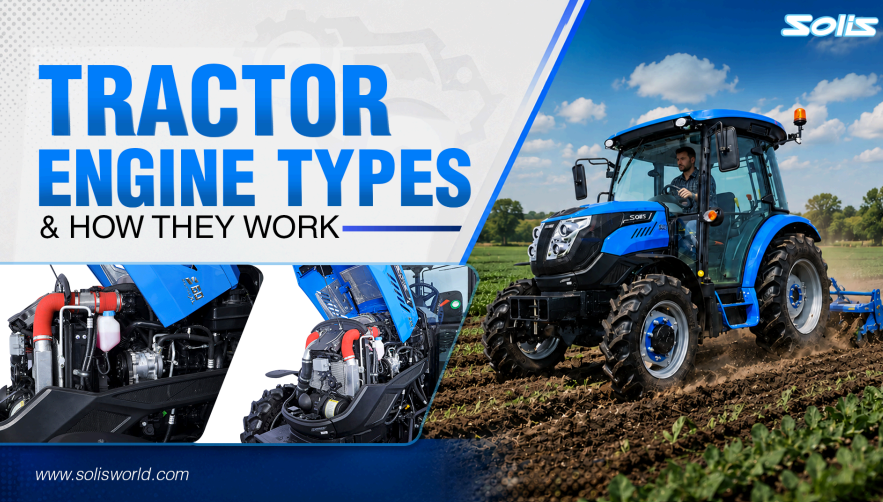
Tractors are available with various types of engines, and almost all modern farm tractors use diesel engines. However, each diesel engine is designed differently, delivers unique benefits and features distinct working mechanisms. However, most buyers still pick a tractor based on horsepower. That’s where it’s important to understand that the types of tractor engines inside your tractor matter far more for productivity, torque, fuel consumption and reliability.
Not only the type, understanding “how does a tractor engine work” will also help you use it more efficiently, carefully and assist you in shaping your field work. Below, let’s discuss the various types of engines modern tractors feature, so that you can pick the ideal type for your requirements.
Diesel engines became the standard choice for tractors in the 1930s for their capability of delivering high torque at lower RPMs. This results in a more efficient combustion process and better long-term durability. By the 1960s, petrol engines were almost replaced and fast-forward today, nearly all tractors use diesel engines, from compact to heavy-duty.
Types Of Tractor Engines
1. Diesel Tractor Engines
Diesel engines are the most common engines found inside tractors. They burn fuel without a spark plug. Air inside the engine is compressed to roughly 40 to 45 bars (580-650 PSI) and is heated to around 650°C. The extremely hot air ignites diesel. This mechanism delivers high torque at low RPM, making diesel tractor engines perfect for ploughing and towing heavy loads.
Additionally, diesel engines are also preferred for their higher fuel efficiency and durability. For farmers, they are the ideal choice for heavy tasks and daily work. Meanwhile, you can check out how to change your tractor’s engine oil & oil filter to enjoy steady performance and high efficiency.
2. Naturally Aspirated Engines
Naturally aspirated engines are commonly used engines in tractors globally. They pull air into the cylinders through an intake valve without the help of turbochargers or compressors. They perform well in mild climates and for light farming tasks like light tilling and hauling.
These engines are simpler to maintain and repair since they have fewer moving parts, which is also the reason they are less expensive. However, naturally aspirated engines are more prone to struggling at high altitudes or in hotter climates where the air has lower oxygen levels.
3. Turbocharged Engines
Turbocharged engines are widely used in high-horsepower tractors. A turbocharger uses compressed air from a turbine to produce more power and torque. The turbo forces more air into the cylinder, allowing for an efficient combustion process. This creates a true high-torque engine feel when your tasks demand more power.
Turbo-diesel engines are highly effective when it comes to handling heavy loads, steep slopes and managing long hauls without causing powertrain stress. They can also maintain steady power and torque delivery at higher altitudes. This is the reason they are often fitted inside heavy-duty tractors. Many Solis tractors use turbo-diesel engines for these merits.
Types Of Tractor Engines (Based On Stroke)
1. Two Stroke Engines
Two-stroke engines complete a full power cycle in two movements of a piston. They fire on every revolution of the crankshaft to produce quick power bursts. While they are light, they burn oil with fuel, which results in increased emissions. Their high fuel consumption and emission levels are the reason they are rarely used on tractors today.
2. Four-Stroke Engine
Almost all modern tractors today rely on four-stroke engines. Their piston moves four times to complete the intake, combustion, power delivery and exhaust process. This distinct process allows for complete combustion and helps in creating a high torque engine feel. Compared to two-stroke engines, four-stroke engines run cool and can handle heavy-duty tasks more efficiently.
Types Of Tractor Engines Based On Cylinders
The number of cylinders in tractor engines determines the power and torque output, smoothness, and efficiency. More cylinders mean more power and torque, smoother operations and stronger pulling capabilities.
1. Single & 2-Cylinder Engines
Single and two-cylinder engines are less common, and they are widely used in compact tractors and found inside older models. They are simple, cheap, and easy to repair and maintain. They offer high fuel efficiency, but lack power for modern farming challenges.
2. 3-Cylinder Engines
Three-cylinder engines are among the most widely used engine types in tractors. They are highly preferred for their sweet balance of high fuel efficiency, adequate power delivery, compact size and easy maintenance. Many compact and mid-size tractors employ 3-cylinder engines.
3. 4-Cylinder Engines
4-cylinder engines are common in powerful tractors. They are known for their strong outputs, smooth operation, better load handling capabilities and durability. Most mid-size and full-size tractors use 4-cylinder engines, in naturally aspirated or turbocharged forms.
4. 6-Cylinder Engines
If you want raw power and high torque engine feel for demanding applications, 6-cylinder engines are the ones to settle for. These engines are generally used inside heavy-duty tractors. Delivering high horsepower and torque figures, impressive PTO power, smoothness and durability, 6-cylinder engines are the best for large acreage work and heavy-duty tasks.
Final Takeaway
Buying a tractor with the right engine determines your farm’s fuel expenses, power, and longevity. Knowing the types of tractor engines and “how does a tractor engine work” helps you pick tractors wisely. Diesel engines are best for heavy work, while turbocharged models deliver better efficiency and high torque. Newer technologies like hybrid and electric tractors are expensive, but they reduce emissions and fuel costs.
Always match a tractor model with your workflow before buying to ensure you get the best returns. If you’re looking for the most reliable tractors in Europe, buy Solis tractors. Explore our lineup and contact us today for more information.



0 Comments