




















































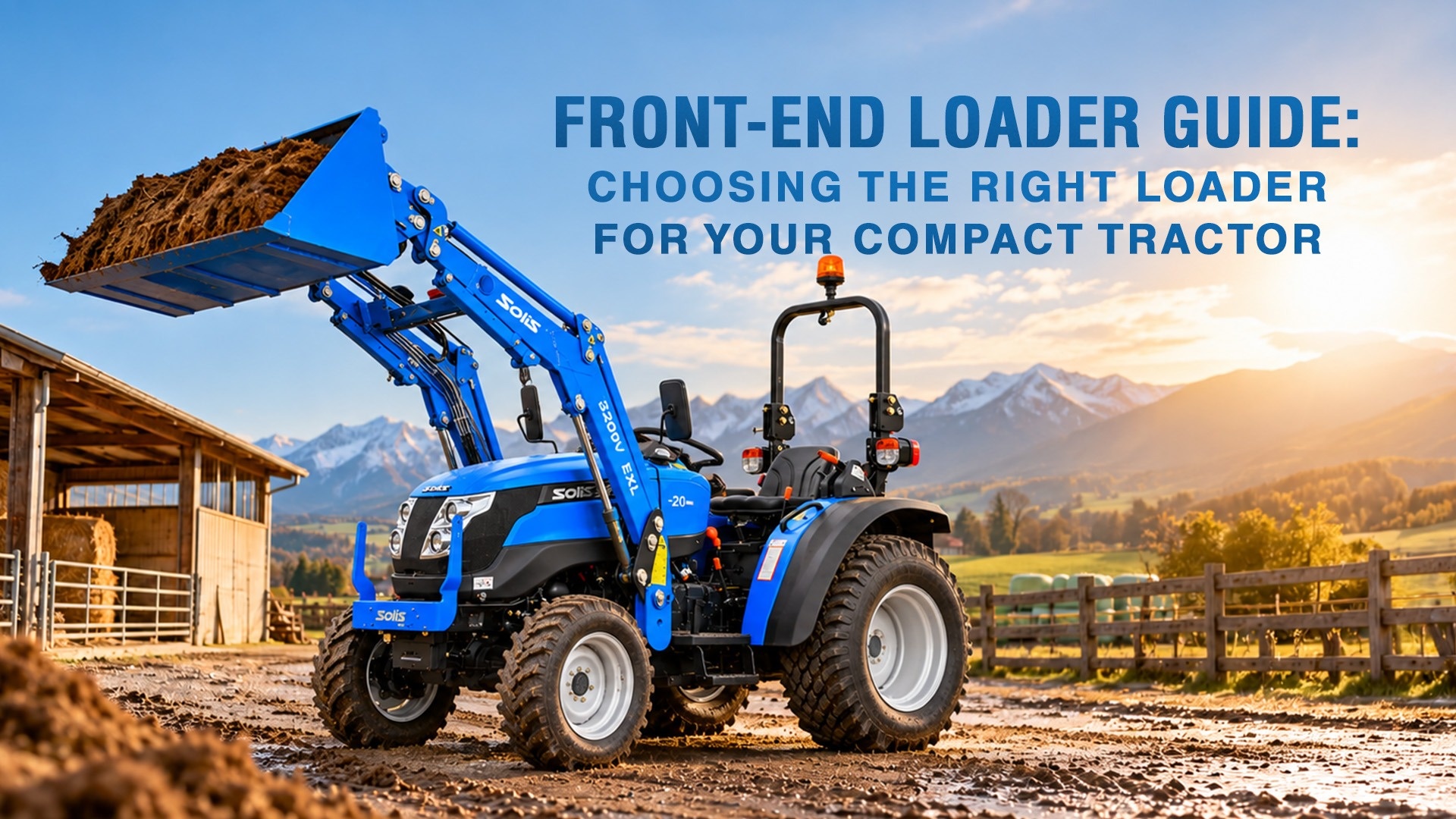
A compact tractor front loader can often look perfect on paper and still lift your rear wheels off the ground on the first full bucket of wet soil. That’s a costly lesson.
Most buyers choose based on price or bucket size alone. Your tractor’s HP, frame and hydraulics decide what it can safely lift, not the bucket. Get that wrong, and you pay for it in slower work, extra wear, safety risk and a second purchase.
This guide gives you a 5-step checklist to run before you pay: tractor match, lift capacity, lift height, attachments and stability. It’s written for compact tractor owners on small farms, orchards and vineyards, the same work Solis compact tractors handle every day. First, see what a loader changes.
How A Loader Changes Everything
A loader turns your tractor from a pulling machine into a lifting machine. Shovelling it takes a weekend and a sore back. A compact tractor front loader moves it in an afternoon. Weight now sits ahead of the front axle. That’s physics, not a flaw in the tractor.
A tractor loader for farm work earns its keep fast. It lifts, carries and clears. Your tractor can move soil, gravel, mulch, hay bales and snow without a second machine or a second person. You push snow before breakfast, shift mulch between orchard rows and stack hay without borrowing a neighbour’s bigger machine, all from one seat.
Solis lists its front-end loaders for tractors from 16 to 110 HP. But the wide range also makes it easy to pick the wrong one.
Step 1: Start With The Tractor
Your compact tractor front loader hangs off the front end and runs on your tractor’s hydraulics, so the tractor sets the limit. Not the loader. Check your tractor manual before you look at a single loader. Three things set the limit: engine HP, frame strength and hydraulic flow. A loader needs oil to lift, and a weak pump means slow, jerky movement.
Start with horsepower. A loader built for a 20 HP tractor looks nothing like one made for a 90 HP tractor. Then look at hydraulic flow. A weak pump makes a good loader slow to lift and slower to tilt. Ask for the mounting kit made for your exact model, since brackets rarely swap between tractors.
Frames are equally essential. Loader arms push force straight into the tractor’s chassis and mounting points. Not every compact tractor is built for it. Solis delivers loader compatibility from 16 to 110 HP, so ask your dealer which loader fits your exact model. A compact tractor front loader that bolts on is not always one that suits your tractor.
It’s essential that you know your tractor well. Watch this video to learn how to know your tractor.
Step 2: Match Capacity To Your Requirements & Tasks
Rated capacity is the number most buyers look for. Solis offers several weight capacities across its loader range. Pick for your heaviest regular load, not the average one.
Here’s the catch. Loader lift capacity is rated at a specific point on the arms. Push the load further out or raise it high, and the safe weight drops. A full bucket of wet soil can weigh far more than it looks.
A pallet of feed, a bucket of gravel, a round bale or a pile of snow each loads the loader differently. Weigh a few typical loads before you decide. The best loader for compact tractor use is the one whose loader lift capacity covers your hardest regular job with capabilities to spare.
Step 3: Check The Lift Height You Need
Lift height decides where you can actually put the load. Solis loaders reach from 1752 to 3380 mm at maximum lift height, roughly 1.75 to 3.4 metres. Which end you need depends on where the load goes. Measure the highest spot you need to reach, whether that’s a trailer side, a bale stack or a shed door, and add some margin.
Orchard owners should check branch height too. Taller isn’t always better. A higher lift raises the load’s centre of gravity, and that hurts stability on slopes. The quoted height is at the pivot pin, so the bucket’s dumping height is lower. Do the sums on reach and loader lift capacity before you buy, not after.
Step 4: Pick The Right Bucket & Attachments
A tractor loader attachment changes what your machine can do. Bucket size trips up more buyers than anything else. A general-purpose bucket handles soil, gravel and mulch. Pallet forks are good for handling feed, fencing supplies and stacked goods. A bale spear or grapple helps to pick hay.
Bucket width matters. Wider moves more material per pass but adds weight at the front and needs more room to turn between orchard rows. Narrower is easier to control. Add a second tractor loader attachment once you know which jobs come next. Check its weight against your loader’s rated capacity, because the attachment counts too. That keeps your tractor loader for farm work safe and productive.
Step 5: Plan For Stability & Safety
A loader shifts your tractor’s balance forward. Add rear ballast or a counterweight to keep the rear wheels planted. Keep loads low while you drive, and slow down on slopes and turns.
Use a ROPS, wear your seatbelt and never lift people with the bucket. If you’re new, spend an hour practising with an empty bucket first. Drive straight up and down slopes, never across them with the bucket raised, since a raised loader lifts your tractor’s centre of gravity. Nobody rides in the bucket. Ever. Ask your dealer about ballast and check your Solis operator manual for model-specific limits.
Quick Match Checklist
- Tractor Match: Confirm the loader is built for your tractor’s model, HP and hydraulic flow.
- Capacity: Match loader lift capacity to your heaviest regular load, then ask where it’s rated.
- Height: Measure your trailer wall or stack, then add clearance for the bucket.
- Attachments: Pick the bucket for your material. Add one tractor loader attachment per real job.
- Stability: Fit rear ballast, carry loads low and keep the ROPS up or the cabin on for any tractor loader for farm work.
- Dealer Check: Ask your Solis dealer to confirm the tractor and loader pairing before you pay.
Solis Compact Tractors Lifting Capacity Listed
| Model | Power | Listed Lifting Capacity |
|---|---|---|
| Solis S16 | 16 hp | 500 kg |
| Solis S20 | 20 hp | 600 kg |
| Solis S20 Plus | 20 hp | 600 kg |
| Solis S22 | 22 hp | 600 kg |
| Solis S26 | 26 hp | 600 kg/775 kg (Optional) |
| Solis S26 Shuttle XL | 26 hp | 600 kg/775 kg (Optional) |
| Solis S50 Shuttle XL Cabin | 50 hp | 2,500 kg |
| Solis S50 Shuttle XL ROPS | 50 hp | 2,500 kg |
| Solis S60 Shuttle XL | 60 hp | 2,500 kg |
| Solis S60 Shuttle XL Cabin | 60 hp | 2,500 kg |
| Solis S75 Shuttle XL | 75 hp | 2,500 kg/3,000 kg (Optional) |
| Solis S90 Shuttle XL | 90 hp | 3,000 kg/3,500 kg (Optional) |
| Solis S90 Shuttle XL Cabin | 90 hp | 3,000 kg/3,500 kg (Optional) |
Final Thoughts
Across the Solis line, horsepower range expands from 16 HP to 90 HP. Lifting capacity ranges from 500 kg on the S16 to 3500 kg on larger models like the Solis S90 Shuttle XL Cabin. The right loader comes down to five checks: your tractor’s limits, the weight you lift, the height you need, the attachment you use and the stability you build in. Get them right, and your tractor handles soil, hay and snow with less effort and less risk.
Are you ready to buy a Compact tractor front loader? Compare specs on our front-end loader page, or contact us for enquiries. Share your tractor model and your heaviest job. Our dealers can recommend the best loader for compact tractor use on your land, whether that means hay on a small farm or mulch in an orchard.



0 Comments